Home / Treatments / ACL surgery
A torn ACL is replaced with a graft — tissue that will become your new ligament. Choosing it well is the first big decision of the operation, and it's a decision we make together.
A completely torn ACL does not heal on its own with enough strength to stabilise the knee. That's why surgery doesn't "stitch" the ligament: it reconstructs it with a graft anchored in the femur and tibia, reproducing the original anatomy. Over the following months the graft revascularises and remodels until it behaves like a native ligament — a process called ligamentisation.
There are four main graft sources. The first three are your own tissue (autograft); the fourth comes from a donor.
The central third of the patellar tendon, with a bone block from the kneecap and another from the tibia.
The semitendinosus tendon, sometimes with gracilis, from the back of the thigh.
The central portion of the quadriceps tendon, above the kneecap.
Bank tissue from a donor.
| Graft | Tunnel healing | Donor site | Failure in young athletes | Typical profile |
|---|---|---|---|---|
| BTB | Bone-to-bone, the most solid | Possible anterior discomfort | The lowest among autografts | Pivoting-sport, high-demand athlete |
| Hamstring | Tendon-to-bone, slower | Very little discomfort | Somewhat higher than BTB | Recreational activity, no pivoting |
| Quadriceps | Good (with or without bone block) | Little discomfort | Comparable to BTB | Versatile alternative; revisions |
| Allograft | The slowest | None | The highest | Revisions; lower demand |
Orientative synthesis of recent literature (see references). Every case needs individual assessment.
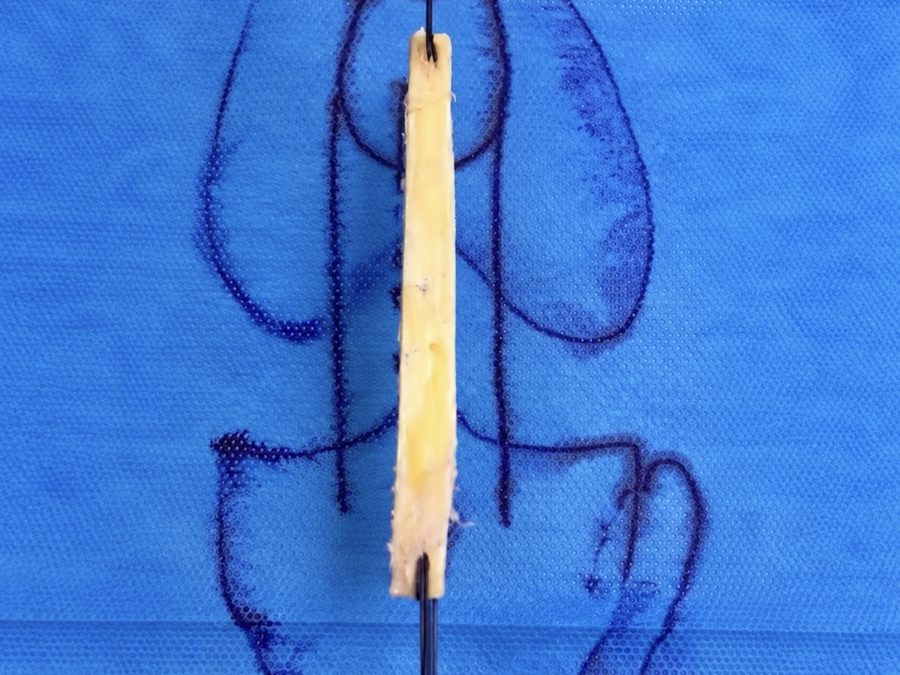
From my experience in sports traumatology, in athletes and high-demand patients my usual choice is the bone–patellar tendon–bone graft. Its two bone blocks heal bone-to-bone inside the tunnels — a fast, very solid biological fixation — and recent reviews attribute to it a lower failure rate than hamstring grafts, faster maturation and a tendency towards better return to the pre-injury level of sport.
Its trade-off is an honest one: some patients notice pain at the front of the knee or when kneeling, which modern harvesting techniques and rehabilitation reduce. And it's not a dogma: the final choice is made together with you, based on your sport, age, anatomy and priorities.
The two bone blocks sit inside the femoral and tibial tunnels, where they heal bone-to-bone.
In specific profiles — young pivoting-sport athletes, hyperlaxity, revision surgery — the graft alone may not fully control the rotation of the knee. In those cases we add a lateral reinforcement in the same operation: the Lemaire tenodesis. When and why, explained in its own article.
There isn't a universally superior one: each has advantages and trade-offs, and the choice is individualised. In pivoting-sport and high-demand athletes, current evidence particularly supports BTB, which is my usual choice in that profile.
The donor site heals and remodels over the months, and studies show no significant medium-term difference in extensor strength versus other grafts. The real trade-off is possible discomfort at the front of the knee or when kneeling in some patients.
Yes: it revascularises and remodels over months until it behaves like a native ligament (ligamentisation). That's why return to sport is decided by objective criteria, not fixed dates.
The choice depends on the previous graft, the state of the tunnels and the cause of failure: BTB, quadriceps or allograft are frequently used, and in most revisions we also add the Lemaire tenodesis.
In clinic we assess your knee, your scans and your sport — and decide the graft and technique together.
Or by phone: +34 681 87 65 04
