Home / Treatments / Lemaire tenodesis
In high-risk knees, reconstructing the cruciate ligament is sometimes not enough on its own. The Lemaire tenodesis is an external reinforcement we add in the same operation to protect the graft.
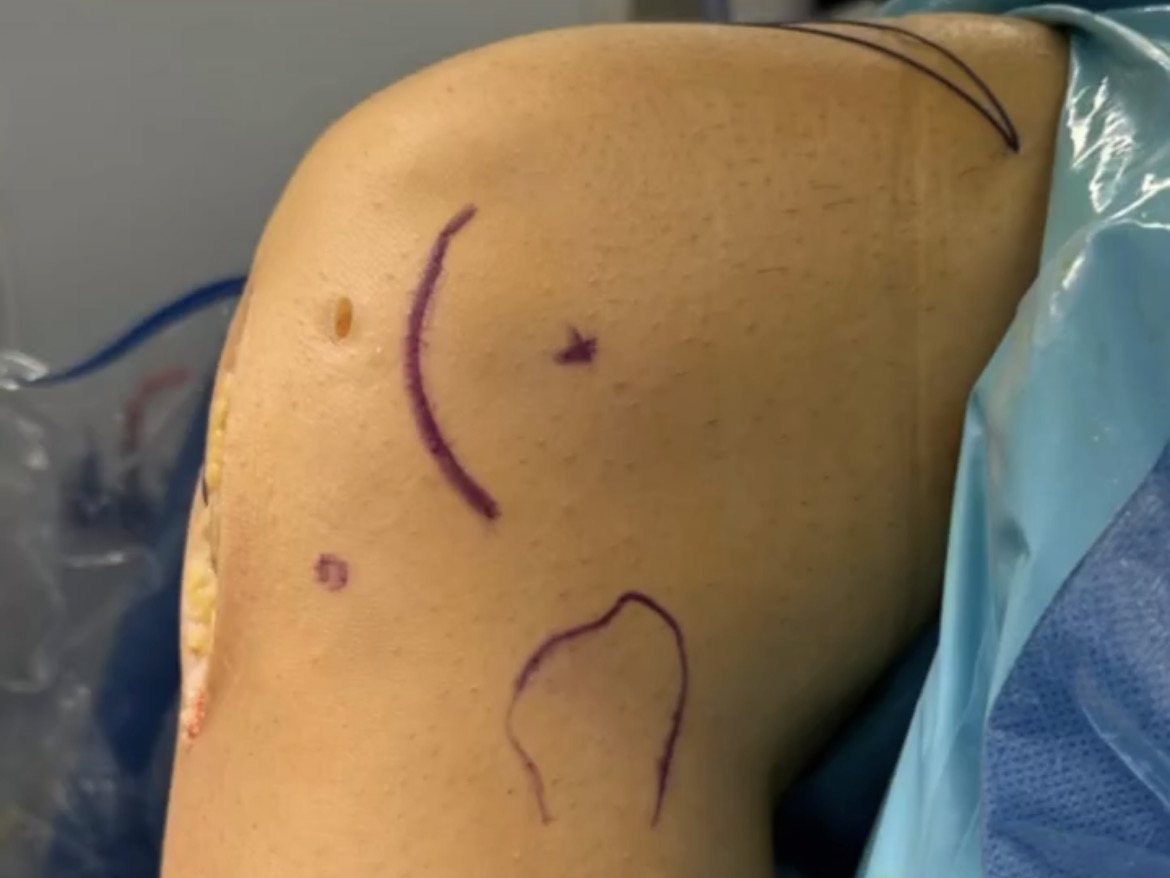
The Lemaire tenodesis uses a strip of your own iliotibial band — the fibrous tissue on the outer side of the thigh — left anchored at the tibia. That strip is passed underneath the lateral collateral ligament and fixed to the femur. The result is an additional brake on the internal rotation of the knee, exactly the movement an ACL-deficient knee struggles with most. It needs no additional graft and is done through a small lateral incision.
The rotational stability of the knee doesn't depend on the ACL alone: on the outer side there is a group of structures — the anterolateral complex, including the iliotibial band and its fibre attachments to the femur — that acts as a secondary restraint to rotation. Biomechanical studies show that when this complex is also damaged, isolated ACL reconstruction may not restore full stability, and the phenomenon we call the pivot shift persists: that feeling of the knee "giving way" when turning.
This matters because residual rotation overloads the graft: in high-risk patients treated with isolated ACL reconstruction, the literature reports graft failure rates of up to 20–35%.
Not in every knee — in the profiles where the evidence has shown it helps. I assess it in clinic and confirm it with the examination under anaesthesia:
The STABILITY clinical trial — 618 young high-risk patients, the most rigorous study published to date — compared ACL reconstruction with and without lateral reinforcement:
Subsequent meta-analyses confirm better stability and lower failure rates when the lateral reinforcement is added in these profiles.
The iliotibial band strip (blue) passes under the lateral collateral ligament and is fixed to the femur: an external brake on rotation.
A little, and it is only fair to say so. The tenodesis adds a few minutes to the same operation and an incision of a few centimetres on the outer side of the knee, through which the iliotibial band strip is harvested and fixed. That additional surgical site means the pain in the first few days is greater than after an isolated ACL reconstruction: it is localised to the outer side of the knee, is controlled with the usual pain relief and settles over the first weeks.
The overall rehabilitation protocol is the same as for the ACL reconstruction, and in the STABILITY trial adding it did not increase complications. In exchange for those more uncomfortable first weeks, the graft reaches your return to sport protected.
Only if your profile justifies it: young patients returning to pivoting sport, high-grade pivot shift, hyperlaxity, hyperextension or revision surgery. If your risk is low, isolated ACL reconstruction is usually enough. It's decided in clinic and confirmed with the examination under anaesthesia.
A few minutes within the same operation and a lateral incision of a few centimetres. In exchange, the pain in the first days is greater than after an isolated ACL reconstruction: localised to the outer side of the knee and controlled with the usual pain relief. Overall rehabilitation is the same, and no increase in complications has been seen.
No: it's a complement. The reconstructed ACL remains the main stabiliser; the tenodesis is an additional brake that protects it.
Two variants of lateral reinforcement with the same goal, with no clear superiority of one over the other in comparative evidence. The modified Lemaire uses a strip of your own iliotibial band, with no need for another graft.
We assess your case in clinic — examination, scans and your sport — and decide together whether your knee needs the reinforcement.
Or by phone: +34 681 87 65 04
