Home / Treatments / Knee arthroscopy
Small incisions, a direct view of the joint, and one clear priority: preserving your knee. The meniscus is its shock absorber and, whenever the tear allows it, we repair it rather than trim it.
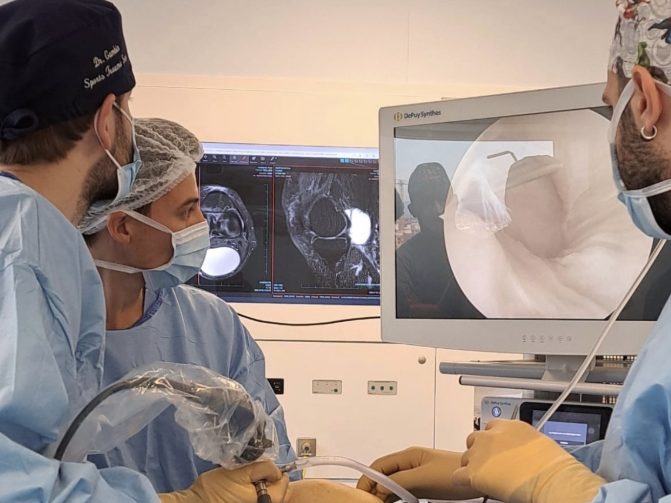
Arthroscopy lets us see and treat the inside of the knee through two or three incisions of under a centimetre, using a high-definition camera and specialised instruments. Compared with open surgery it means less tissue damage, less post-operative pain and a faster recovery. It is the core tool of sports traumatology — and the technique I subspecialise in.
The menisci distribute load between the femur and tibia and protect the cartilage with every step. When meniscal tissue is lost, that load concentrates: studies show that after a meniscus injury the risk of developing osteoarthritis multiplies roughly six-fold. That's why the European expert consensus (ESSKA) sets meniscus preservation as the primary goal — and why my first question in front of any tear is not "what do I trim?", but "can it be repaired?". Trimming is sometimes unavoidable, but it should never be the default.
The first distinction is fundamental. Traumatic tears appear acutely after a specific event — a twist, a tackle, an awkward landing — often in younger people and frequently alongside an ACL rupture. Degenerative tears, on the other hand, come from wear, without a clear injury, and in most cases are not operated on initially: their first-line treatment is conservative. What follows is mainly about the former — the ones we consider repairing.
Meniscus healing depends above all on the blood supply of the torn zone and the tear pattern. Repair has the best chances when these conditions are met:
Location isn't everything: the ESSKA consensus notes that even tears in the innermost zone have shown good results in selected patients — so no tear is ruled out without a detailed assessment.
The more peripheral the tear, the better its blood supply and the better the repair heals (87–91% in the outer zone).
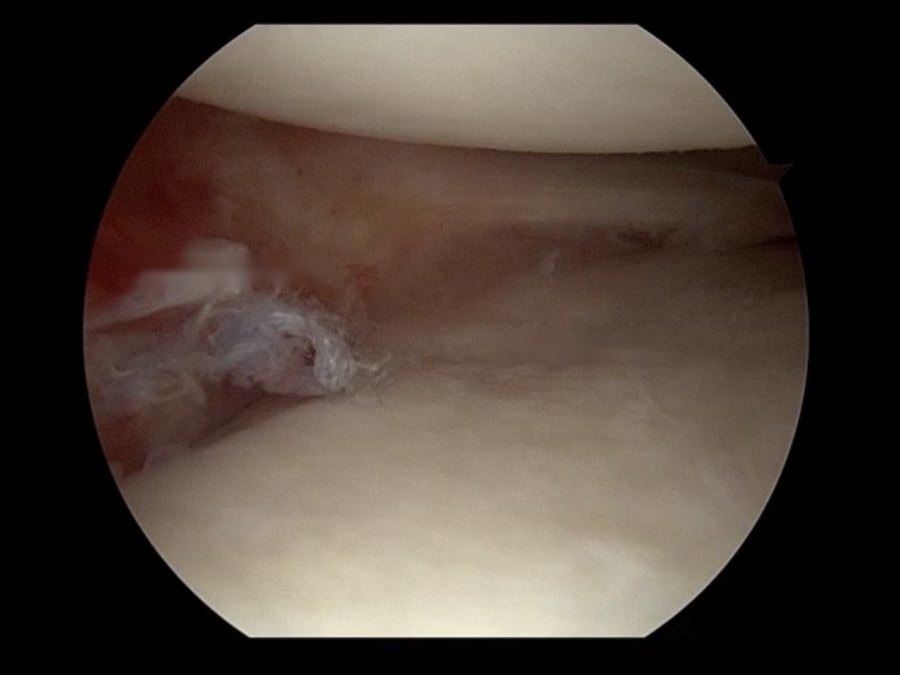
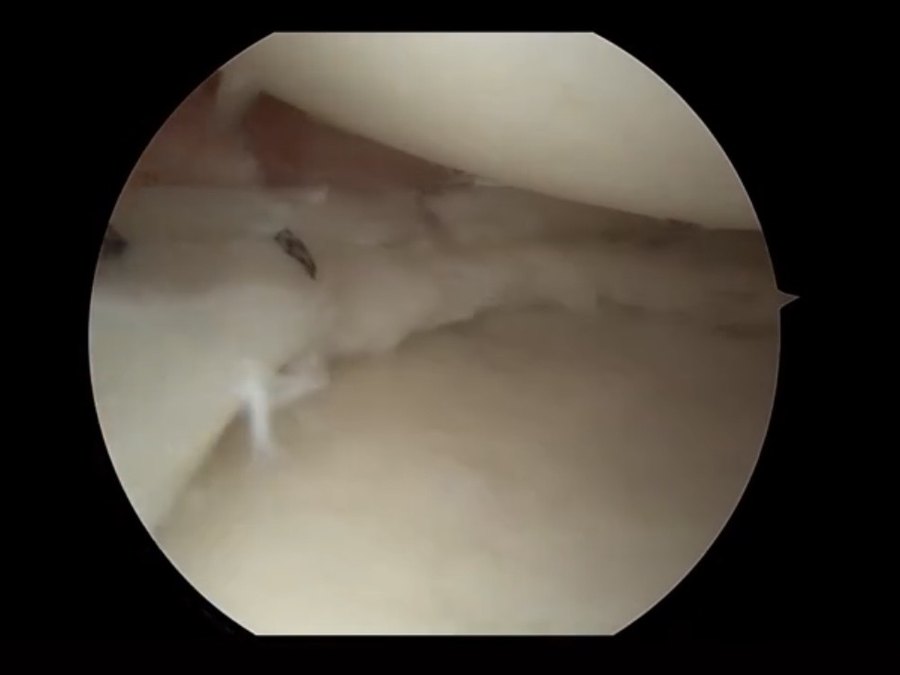
Two images from the arthroscopy camera, of the same knee: the meniscus tear as we found it and that same meniscus once repaired.
When the tissue is too damaged or the tear pattern is not repairable, the right option is a minimal partial meniscectomy: removing only the essential fragment while preserving the whole peripheral rim. What the consensus makes clear is the order of priorities: trimming should not be the first choice in a repairable tear, because its long-term outcome is worse than repair.
| Meniscus repair | Partial meniscectomy | |
|---|---|---|
| The meniscus | Is preserved | Part is lost |
| Recovery | Slower: healing must be protected (sport ~4–6 months) | Fast (weeks) |
| The knee's future | Less osteoarthritis, more activity long-term | Higher osteoarthritis risk |
| Reoperation | Possible if the repair doesn't heal | Less frequent short-term |
Orientative synthesis of the ESSKA consensus (see references). Every case needs individual assessment.
The 2019 ESSKA consensus on traumatic meniscus tears — drawn up by Europe's knee experts — summarises the evidence like this:
And one central recommendation: partial meniscectomy should not be the first-line treatment for repairable tears — repair offers less osteoarthritis, higher activity levels and greater satisfaction in the long term. The consensus itself points out that in everyday practice, fewer menisci are repaired than could be.
Knee arthroscopy is usually a day-case or short-stay procedure, with anaesthesia tailored to each patient, at IMED Elche or IMED Alicante hospitals. Typical duration is 30 to 60 minutes depending on the procedure. You leave hospital walking with protected support and a written recovery plan.
Swelling control, early motion, and weight-bearing according to the procedure (immediate after meniscectomy; protected after repair).
Normal gait and basic strength after partial meniscectomy; healing protection after meniscus repair.
Progressive return to general activity; guided load and motion progression after repair.
Return to sport depending on the procedure and on strength and control criteria — earlier after meniscectomy, later after repair.
No. Degenerative tears, caused by wear, appear without a clear injury and in most cases are not operated on initially: first-line treatment is conservative, with exercise and symptom control. Surgery is for mechanical pain, locking or recurrent swelling, and for traumatic tears in younger patients, where the aim is also to repair.
No: repair works best in recent traumatic tears, vertical or longitudinal, in the peripheral vascular zone and with good-quality tissue; root tears are also repaired. If the tissue is not repairable, only the essential part is removed.
If the tear allows it, repair: every fragment lost concentrates load on the cartilage, and the risk of osteoarthritis after a meniscus injury multiplies roughly six-fold. Recovery is slower than trimming, but for young, active patients it is usually worth it. If the tear is not repairable, only the damaged fragment is removed.
It may need a second arthroscopy, usually to remove the fragment. Even with that risk, repair is worth it in the right tears: it heals in around 87–91% of cases in the peripheral zone and protects the knee long-term.
As a guide: normal life within 2-4 weeks after a partial meniscectomy; longer after a meniscus repair (4-6 months for sport) to protect healing. Each case gets an individual plan.
Generally it is not the treatment for established osteoarthritis; options there range from conservative care and injections to surgery in advanced stages. Arthroscopy is for well-selected mechanical problems.
A timely examination tells apart what will settle with conservative care from what should be operated on early to save the meniscus.
Or by phone: +34 681 87 65 04
